
The U.S. has gained more than sixty new pharmacy schools since 2000.1 Since then, NAPLEX pass rates have slumped and attrition rates have risen.2,3,4 However, not all schools have dismal outcomes. The statistics show that certain schools are dragging down national NAPLEX pass rates.5 Prospective students need unbiased information about programs before applying. There is some objective data available: residency match, graduation, employment, and NAPLEX pass rates. Accreditation status and history are also useful data points. These data are available for public consumption but are not always easy to find. Schools and agencies need to increase transparency, so students can assess school quality.
A Doctor of Pharmacy is only useful if a student can find a job. Graduation and employment rates are useful in determining a school’s quality. Schools post these rates on their websites. Students should also review residency match rates if they want to pursue residency. The ASHP releases five years of match statistics for each school on their website.6 This allows students to review multiple schools at once. These rates may seem minor but can help applicants make informed decisions.
A major criterion for determining school quality is NAPLEX pass rates. In this post, I discussed the decline of NAPLEX pass rates and its potential causes. Since then, I discovered what happens to schools with abysmal pass rates. The Accreditation Council for Pharmacy Education (ACPE) accredits pharmacy schools. The ACPE takes notice when a school’s NAPLEX pass rate is two standard deviations below the national average.7 If a school’s percentage dips that low for the first time, then the ACPE sends a letter to the school. The letter insists that the school take action to improve first-time pass rates. Starting in July 2025, the ACPE will implement their updated standards. The new standards will allow for three years of low pass rates without accreditation changes (see Figure 1).8 I agree with allowing time to adjust curriculum, but probation could occur sooner. Probation status does not affect current students. They still graduate from an accredited program. It would, however, make prospective students think twice before applying to said program. This is why potential students should check a school’s NAPLEX pass rates.
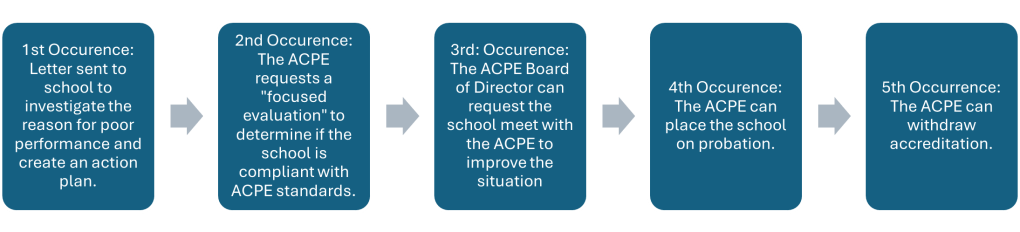
Figure 1. ACPE actions following a school’s NAPLEX pass rate being below the national average by at least two standard deviations within a 7-year period.8
Prospective pharmacy students can check accreditation status on the ACPE’s website.9 The website groups pharmacy schools by accreditation status: accredited, accredited with probation, candidate, discontinued/merged, no status awarded, precandidate, and withdrawn. Accredited schools are those that have no known compliance issues.7 Precandidate and candidate schools are in the process of becoming accredited.7 No status awarded means the ACPE did not award precandidate status.10 Withdrawn means the ACPE removed a program’s accreditation or pre-accreditation status.11 Discontinued is the voluntary closing of a pharmacy school.12 Accreditation with probation means that the school is partially compliant with one or more standards. The school retains its accreditation status.7 A student can click on a probation school’s ACPE profile. The profile will list the partially compliant standard with a link to the standard.13 Students should also review ACPE profiles for fully accredited schools. Their profiles contain any previous warnings or probations.
Public reporting of schools on probation is useful but does not explain everything. The ACPE profile does not list the exact reason the school is noncompliant. I found the reason for one school being partially compliant by accident. I reviewed a June 2024 Report of Proceeding from the ACPE. The report lists a detailed explanation for why the ACPE placed the school on probation. The school’s ACPE profile does not reference the June 2024 report. The ACPE should place these details on their school profiles. The June 2024 report states that the school is on probation due to low NAPLEX pass rates.14 A prospective student can find the low pass rates without visiting the ACPE website. However, non-NAPLEX compliance issues may not have public data available. The ACPE should add the details that led to probation to the school’s profile. This specific probation also highlights ACPE’s slow action regarding NAPLEX pass rates. The June 2024 report also states that the ACPE will visit the school in Spring 2026, almost two years later.
Prospective pharmacy students must perform their due diligence. Applying to pharmacy school requires research. Applicants should review a school’s accreditation status and history, NAPLEX pass rates, and post-graduation prospects. When the ACPE identifies an issue, they are slow to act and make the details difficult to find. The ACPE needs to improve their school profile pages. Applicants should not have to dig through reports to learn why schools are on probation. Students need impartial data to ensure they will invest in a quality education.
References
- Brown D. Years of rampant expansion have imposed Darwinian survival-of-the-fittest conditions on US pharmacy schools. Am J Pharm Educ. 2020;84(10):1277-1281. doi: 10.5688/ajpe8136.
- Ried L, Hunter T, Bos A, Ried D. Association between accreditation era, North American Pharmacist Licensure Examination testing changes, and first-time pass rates. Am J Pharm Educ. 2023;87(3):345-355. doi: 10.5688/ajpe8994.
- Profile of Pharmacy Students Fall 2022. American Association of Colleges of Pharmacy (AACP). 2022. Accessed September 9, 2024. https://view.officeapps.live.com/op/view.aspx?src=https%3A%2F%2Fwww.aacp.org%2Fsites%2Fdefault%2Ffiles%2F2023-06%2Ffall-2022-pps-enrollments-appendix_0.xlsx&wdOrigin=BROWSELINK
- Profile of Pharmacy Students Fall 2021. American Association of Colleges of Pharmacy (AACP). 2021. Accessed September 9, 2024. https://view.officeapps.live.com/op/view.aspx?src=https%3A%2F%2Fwww.aacp.org%2Fsites%2Fdefault%2Ffiles%2F2023-06%2Ffall-2021-pps-enrollments-appendix.xlsx&wdOrigin=BROWSELINK
- Williams J, Spivey C, Hagemann T, Phelps S, Chisholm-Burns M. Impact of pharmacy school characteristics on NAPLEX first-time pass rates. Am J Pharm Educ. 2019;83(6):1366-1372. doi: 10.5688/ajpe6875.
- ASHP Match Statistics. National Matching Services Inc. Updated 2024. Accessed September 10, 2024. https://natmatch.com/ashprmp/stats.html
- PharmD Program Accreditation. Accreditation Council for Pharmacy Education. Accessed October15, 2024. https://www.acpe-accredit.org/pharmd-program-accreditation/
- Accreditation Council for Pharmacy Education. Policies and procedures for ACPE accreditation of professional degree programs. June 2024. Accessed October 16, 2024. https://www.acpe-accredit.org/pdf/CSPoliciesandProceduresJune2024.pdf
- Programs by Status. Accreditation Council for Pharmacy Education. Accessed October15, 2024. https://www.acpe-accredit.org/accredited-programs-by-status/
- Accreditation Council for Pharmacy Education. ACPE statement of the reasons for denial of preaccreditation status. Accessed October 15, 2024. https://apps.acpe-accredit.org/standApp/upload/ACPEStatementOfTheReasonsForWithdrawalOfAccreditationStatusCHSUJan2022LH.pdf
- Accreditation Council for Pharmacy Education. Hampton University School of Pharmacy. Accessed October 15, 2024. https://www.acpe-accredit.org/faq-item/Hampton-University-School-of-Pharmacy-PharmD/
- Accreditation Council for Pharmacy Education. South Caroline College of Pharmacy (PharmD). Accessed October 15, 2024. https://www.acpe-accredit.org/faq-item/South-Carolina-College-of-Pharmacy-PharmD/
- Accreditation Council for Pharmacy Education. American University of Health Sciences School of Pharmacy (PharmD). Accessed October 15, 2024. https://www.acpe-accredit.org/faq-item/American-University-of-Health-Sciences-School-of-Pharmacy-PharmD/
- Accreditation Council for Pharmacy Education. Report of proceedings June 12-14, 2024. June 2024. Accessed October 16, 2024. https://www.acpe-accredit.org/pdf/ReportofProceedingsJune2024FINAL.pdf
 Dahlia Medical Communications
Leave a comment